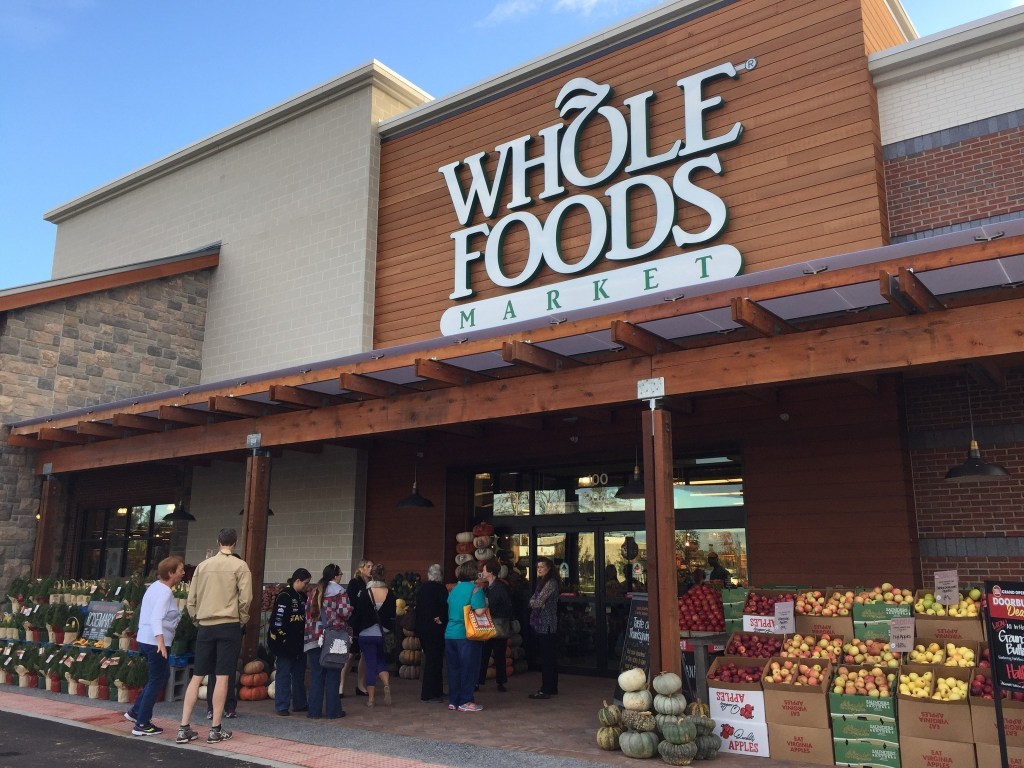
On the 15th June 2017, Amazon’s purchase of organic & natural food giant Whole Foods Market was valued at $13.7 billion, $42 per share. Amazon had long-intended to enter the traditional retailing industry and the move was recognized as a game-changer due to its adverse effects on shares of rival grocers alongside a 29% skyrocket in Whole Foods stock. This post will explore the extent to which the merger can be considered a success and whether predictions made in 2017 have become a reality.
Challenges
At the time of the purchase, Whole Foods faced a variety of challenges and had been losing substantial revenue to competitor Kroger. In February 2017, Whole Foods had expressed their plans to close nine stores and lower financial projections for the year due to slowing sales growth and competition. Only months later in April, Whole Foods admitted their sixth consecutive quarter of declining sales which was largely blamed on their high prices and the availability of similar products at a lower cost. Due to the disappointing results, Whole Foods faced ‘dissatisfaction from investors’, a revision of board members and the transferral of significant debt to Amazon.[1] Particularly harsh criticism emerged from activist investor Jana Partners and money manager Neuberger Berman who suggested the necessity for Whole Foods to sell itself. Investors criticized Whole Foods’ poor performance, ‘very expensive real estate and high prices’.[2] These observations were particularly meaningful in light of Amazon’s opposing stance, their focus on affordability and practicality would surely necessitate adapting to a new model.
Predicted Outcomes
Despite the problems associated several positive outcomes of the deal were predicted. The deal was expected to give Whole Foods ‘financial breathing room… improve its supply chain logistics’ and introduce renovation from the technology side.[3] One of the most appealing forecasts for consumers was the potential for a decrease in prices which featured as a notable complaint prior to the takeover. Business Insider suspected ‘customers will enjoy lower prices on products like Whole Trade bananas, organic avocados, organic large brown eggs, organic responsibly farmed salmon and tilapia’.[4] The possibility of investing in additional areas, more efficient merchandising and logistics was expected to enable these price decreases. Forbes projected the introduction of facial recognition, the removal of cashiers due to a shift towards Amazon Go technology and the ambitious expectation of new methods of payment in the form of Amazon’s own currency.[5] However, Amazon spokesman Drew Herdener said: “plans do not include reducing jobs as the result of the deal and that the company does not plan to automate Whole Foods cashiers jobs with Amazon Go technology”.[6]
Outcome
Recent reports of Whole Foods’ progress indicate that the deal’s outcome was not as promising as expected evidenced through a variety of setbacks. Concerns were raised in 2018 when customers expressed outrage at empty shelves which caused an uproar on social media. Business Insider has recently reported more shortages as shoppers ‘in Washington and California have reported a consistent lack of lettuce…other hard-to-find items have included staples like bread and even sugar at some locations’.[7] Even more problematic is the fact that consumers have swiftly blamed Amazon for the organizational and inventory issues with one consumer claiming a manager had informed them that Amazon had pushed for less stock at the back of the store. Allegedly, Amazon’s order-to-shelf system bypasses stock rooms as shelves are stocked ‘directly from delivery trucks, cutting costs and reducing storage and waste’.[8] Bezos received a poor reception following his decision to cut healthcare benefits for part-time employees triggering many customers to switch to Trader Joe’s.[9] In addition to shortages, another contributor to Whole Foods’ recent problems entails their remodelling of the shopping experience. The Philadelphia customers were disappointed with the removal of their Allegro Coffee stop which was replaced with refrigerators and shelving units. Arguably, this move was driven by a need to combat competition alongside a sense of urgency as Amazon Prime promises to have groceries delivered within two hours.[10] While previously distribution warehouses have been outside urban areas, competition is generating the need for well-established supply chains close to customers. These problems raise important questions for Whole Foods. It is increasingly difficult to identify whether Whole Foods are deviating from their core values and user experience, or whether this shift is an inevitable stage in the evolution of retail. The Philadelphia Inquirer supports the latter viewpoint by claiming ‘supermarkets will stop selling anything besides perishable items… to make room for storing those items, supermarkets will start jettisoning more than just cafes’.[11]
Final Thoughts
In conclusion, Whole Foods does not appear to have experienced significant relief from their previous obstacles and consumer satisfaction has certainly not increased dramatically. A point of further confusion to consumers has been Amazon’s recent decision to open a supermarket concept in Irvine which will be their first grocery store. The launch of a supermarket with a completely distinct branding has induced debate regarding Amazon’s intentions with Whole Foods. To summarize, The Mercury News illustrates the impact of the Amazon-Whole Foods deal with the claim ‘if Whole Foods was home-run, they’d be gobbling up other chains, not starting a new one’.[12]
[1] ‘Amazon to buy Whole Foods for $13.7bn’, BBC News (June, 2017). https://www.bbc.com/news/business-40306099
[2] Sarah Whitten, ‘Whole Foods stock rockets 28% on $13.7 billion Amazon takeover deal’, CNBC (June, 2017). https://www.cnbc.com/2017/06/16/amazon-is-buying-whole-foods-in-adeal-valued-at-13-point-7-billion.html
[3] ‘Amazon to buy Whole Foods for $13.7bn’, BBC News (June, 2017). https://www.bbc.com/news/business-40306099
[4] Ashley Lutz, ‘Amazon is officially buying Whole Foods — here’s everything that will change for customers’, Business Insider France (August, 2017). https://www.businessinsider.fr/us/amazon-buys-whole-foods-changes2017-8
[5] Bruno Aziza, ‘Amazon Buys Whole Foods. Now What?’, Forbes (June, 2017). https://www.forbes.com/sites/ciocentral/2017/06/23/amazon-buyswhole-foods-now-what-the-story-behind-the-story/#49594051e898
[6] Jeffrey Dastin, ‘Amazon to buy Whole Foods for $13.7 billion, wielding online might in brick-and-mortar world’, Reuters (June, 2017). https://www.reuters.com/article/us-whole-foods-m-a-amazonidUSKBN1971QJ
[7] Aly Walansky, ‘Customers are noticing empty shelves at Whole Foods and they aren’t very happy’, Today (January 2020). https://www.today.com/food/customers-are-noticing-empty-shelveswhole-foods-they-aren-t-t172612
[8] Chelsea Cirruzzo, ‘Shoppers Say Two D.C. Whole Foods Are Poorly Stocked. Some Blame Jeff Bezos’, Washington City Paper (January, 2020). https://www.washingtoncitypaper.com/food/article/21111660/shopperssay-two-dc-whole-foods-are-poorly-stocked-some-blame-jeff-bezos
[9] Chelsea Cirruzzo, ‘Shoppers Say Two D.C. Whole Foods Are Poorly Stocked. Some Blame Jeff Bezos’, Washington City Paper (January, 2020). https://www.washingtoncitypaper.com/food/article/21111660/shopperssay-two-dc-whole-foods-are-poorly-stocked-some-blame-jeff-bezos
[10] Inga Saffron, ‘Whole Foods cafes are falling victim to Amazon’s delivery strategy’, The Philadelphia Inquirer (February, 2020). https://www.inquirer.com/columnists/whole-foods-cafe-amazon-deliveryfairmount-philadelphia-inga-saffron-20200211.html
[11] Inga Saffron, ‘Whole Foods cafes are falling victim to Amazon’s delivery strategy’, The Philadelphia Inquirer (February, 2020). https://www.inquirer.com/columnists/whole-foods-cafe-amazon-deliveryfairmount-philadelphia-inga-saffron-20200211.html
[12] Jonathan Lansner, ‘Why is Amazon opening non-Whole Foods supermarkets in California?’, The Mercury News (January, 2020). https://www.mercurynews.com/2020/01/30/why-is-amazon-opening-asupermarket-in-irvine/

